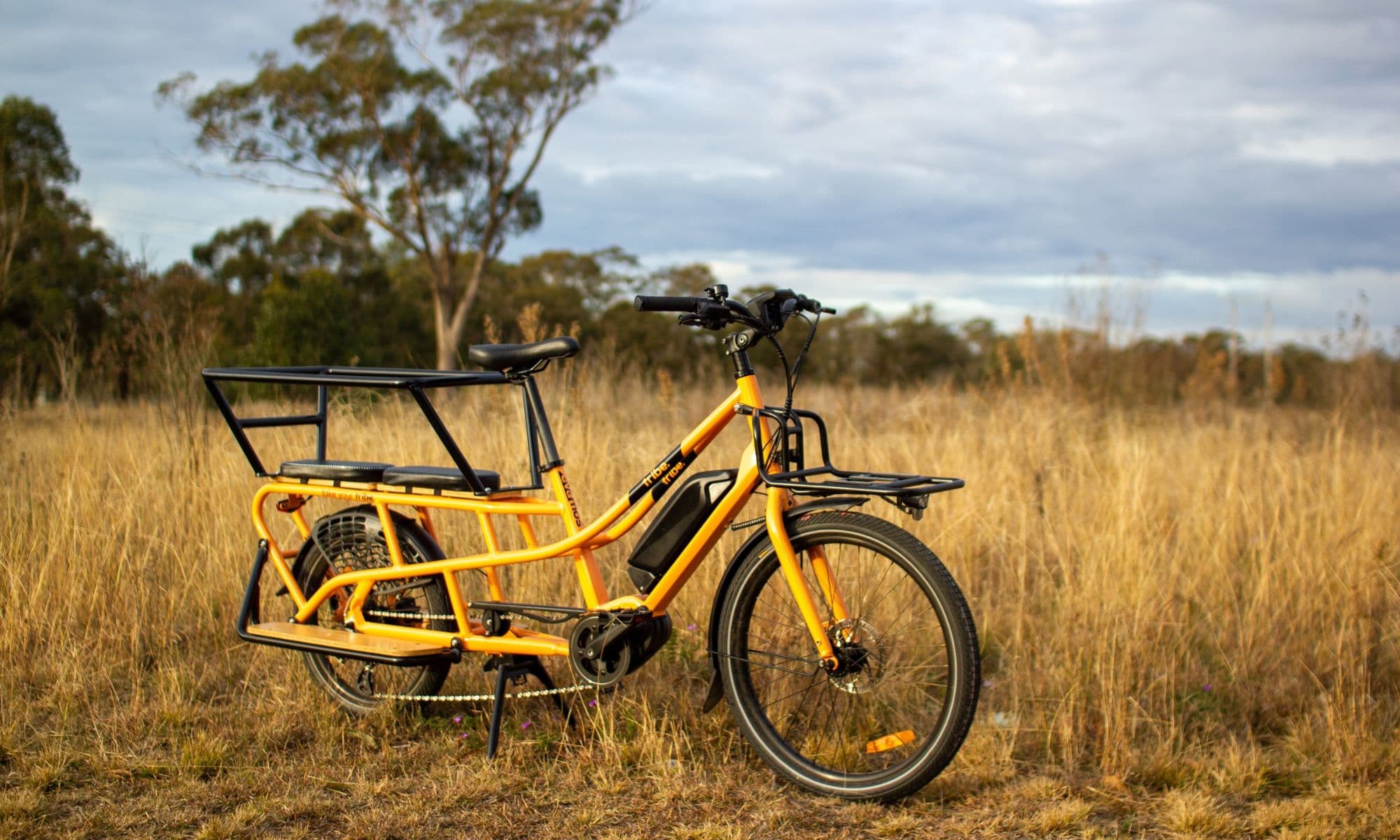
The Tribe Evamos Longtail now ships with a 13Ah battery where it used to have 10.5Ah, which takes it from 375Wh to 468Wh. That’s about 25% more energy on board, and we haven’t moved the price, so it’s still $3,990.
In practice that’s up to 50km on a charge where the old one gave you around 40. Range always depends on what you’re carrying, how hilly your run is and how much assist you ask for, so treat any figure the way you’d treat the fuel economy sticker on a car. Either way, it’s a quarter more energy in the same bike.
Why we haven’t put the price up
The bike costs us more to build than it used to, and our margin on the Evamos is smaller than it was. Nothing got cheaper at our end.
We did it because 375Wh was starting to look small. Battery capacity right across the category has crept up over the last couple of years, and a family sitting down to compare longtails is reading the number off the spec sheet. Ours was becoming the small one, and fair enough if buyers noticed, so we fixed it.
Putting the price up would have defeated the purpose. An upgrade you pay extra for is just a different bike at a different price. The point was to give you more battery for the same money.
We’d rather wear the cost than fall behind. We’re small enough that a thinner margin on our most popular bike gets felt around here, and we looked at it properly before deciding it was worth it.
Battery safety standards
The new pack is tested to EN50604, the European safety standard for light electric vehicle batteries.
If you’ve got an earlier bike, don’t worry: the 375Wh pack is tested to UL2849, the American standard for e-bike electrical systems. Both are proper standards with proper laboratories behind them, and neither is better than the other. UL2849 looks at the electrical system as a whole (the battery, charger and motor together), while EN50604 looks hard at the battery pack on its own.
Both test how the pack behaves when things go wrong: overcharging, short circuits, crushing, vibration, and temperatures well outside anything you’d meet on a school run. A pack that passes either one has been deliberately mistreated in a laboratory and didn’t become dangerous.
You’ve probably read about e-bike battery fires. They trace back to packs that were never tested to any standard at all, to mismatched chargers, and to damaged cells left on charge overnight. We’ve never sold packs like that.
If you already own an Evamos
Unfortunately the two batteries aren’t interchangeable, in either direction. If your Evamos was bought before 26 July 2026 then the 375Wh pack is your battery and the 468Wh won’t fit it, and if your bike is from 26 July onwards it came with the 468Wh and the 375Wh won’t fit that one. So when you order a spare, the date you bought the bike is the only thing you need to check.
There is a bonus if yours is an earlier bike, though. We’ve ended up with a surplus of 375Wh packs and have dropped them from $399 to $249 to clear them, the lowest price we’ve ever put on one. It’s the same UL2849 tested pack your bike came with. If you’ve been thinking about a second battery for the school run then now is the time, and we’d much rather they were out on bikes than sitting on our shelf.
Everything else is the same
It’s the same motor, frame, Shimano Cues 9-speed and brakes as before. Only the battery has changed.
If you’ve got questions, email hello@tribebikes.com.au.